Expanding Healthcare Recruitment Capacity Without Expanding Internal Headcount
For today’s nursing leaders, clinical excellence depends on getting the right clinicians into the
Read MoreWhen was the last time your nurse managers had bandwidth to focus on retention strategies, quality

Read MoreThe just-released SIA report shows that healthcare staffing revenues are expected to decline by

Read MoreThe healthcare industry has become an increasingly complex balancing act. Between regulatory

Read MoreIn a time when the nursing workforce faces unprecedented challenges—burnout, turnover, and
Read MoreOver the past few years, since the turbulence of the pandemic, healthcare organizations' main focus

Read MoreIn the dynamic and unpredictable business of modern healthcare, the importance of an adaptable and

Read MoreHealthcare as a whole has seen staffing challenges for decades now, with nursing staff taking the

Read MoreWe are pleased to introduce Amanda Wheeler, RN, BSN, MBA, as HWL's new VP of InSourcing (IRP)!

Read MoreRecent years have seen the healthcare industry battling increasing obstacles, but according to

Read MoreManaged service providers (MSPs) assume the responsibility of managing multiple healthcare staffing

Read More


For today’s nursing leaders, clinical excellence depends on getting the right clinicians into the right units — all while maintaining compliance, controlling labor costs, and supporting care teams in a challenging workforce landscape.

When was the last time your nurse managers had bandwidth to focus on retention strategies, quality initiatives, or staff development without being buried in candidate phone screens?

The just-released SIA report shows that healthcare staffing revenues are expected to decline by about 6% year-over-year in 2025, to ~$39.4 billion. But there’s a silver lining: signs point toward stabilization, and modest improvement is projected in 2026.

The healthcare industry has become an increasingly complex balancing act. Between regulatory changes, staffing shortages, and patient volume fluctuations, running a healthcare organization today feels like performing surgery while the operating room transforms around you. The question isn't whether unexpected challenges will hit your facility—it's when, and how ready you'll be to handle them.

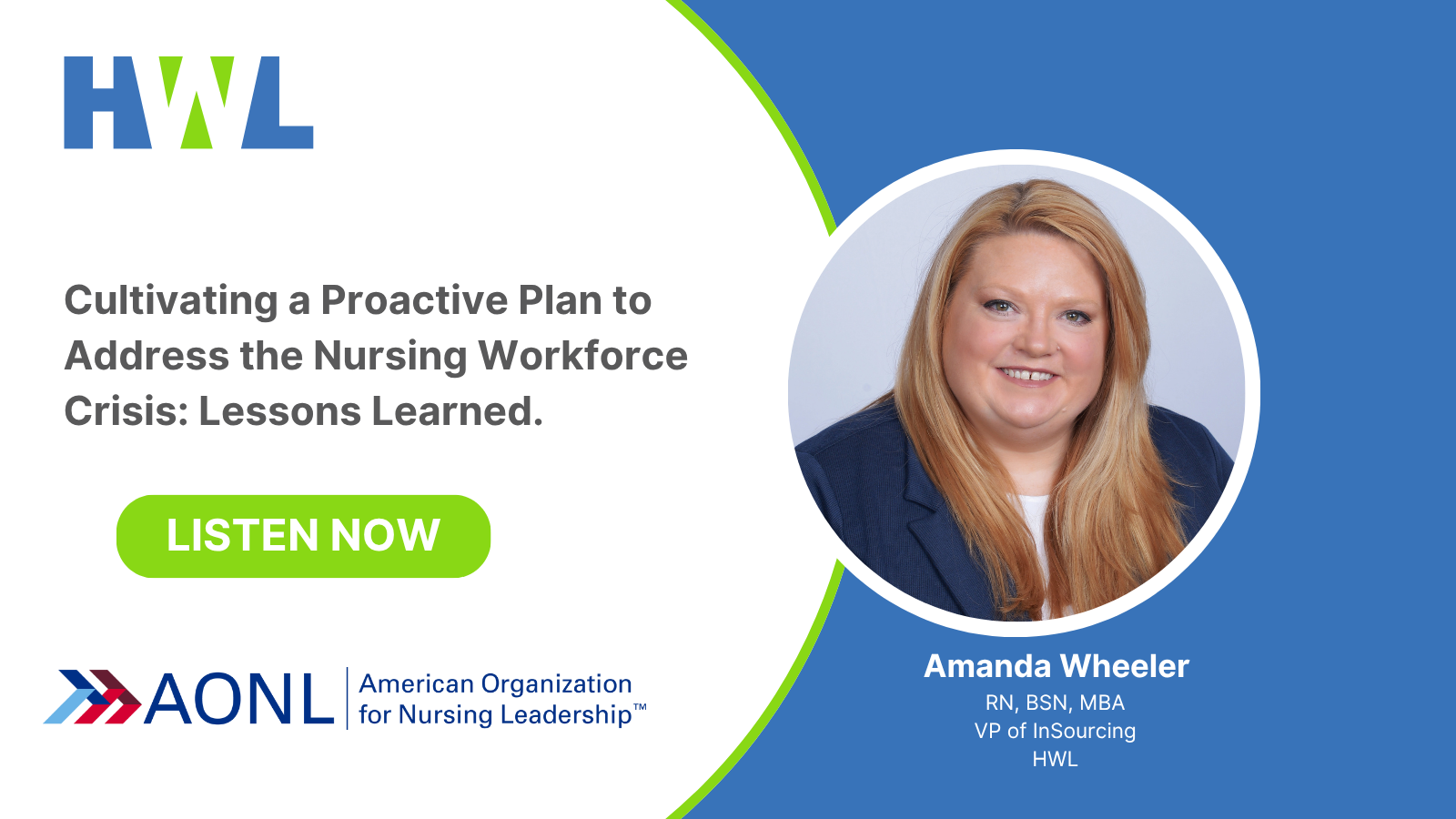
In a time when the nursing workforce faces unprecedented challenges—burnout, turnover, and unsustainable costs—healthcare leaders must look beyond reactive staffing models. At this year’s AONL Annual Conference, Amanda Wheeler, Vice President of InSourcing at HWL, sat down with the AONL podcast team to discuss how organizations can shift from scrambling to fill shifts to building resilient, future-ready workforce strategies.

Over the past few years, since the turbulence of the pandemic, healthcare organizations' main focus has been having enough staff to fill vacancies due to increased demand and surges in patient volume. This led to unprecedented rates of burnout, permanently changing the course of staffing history as organizations became dependent on contingent labor.

In the dynamic and unpredictable business of modern healthcare, the importance of an adaptable and resilient workforce cannot be overstated. After we experience the annual year end mad dash of elective procedures patients schedule strategically to beat resetting deductibles and the long winter months of seasonal illness that require us to “staff up” for volumes, late Spring & Summer can be deceptive seasons for healthcare leaders as patient volumes decrease and staffing appears to “stabilize.” Inevitably, the reprieve is always short lived, so it is imperative we spend those calmer times planning, implementing and/or optimizing our workforce strategies for the next evolution. Even healthcare systems currently experiencing low turnover rates and minimal reliance on external contingent labor should consider investing in and optimizing an internal resource pool, or Local Insourced Flex Team (LIFT). This strategic move is crucial in addressing seasonal fluctuations in patient volume, unexpected staff absences, and the prolonged time required to fill vacancies. Additionally, it provides a local solution to the ongoing nursing shortage and serves as a retention mechanism by offering flexible work options, alternatives to travel nursing & competitive compensation that benefit both the organization and its employees.

Healthcare as a whole has seen staffing challenges for decades now, with nursing staff taking the brunt of it. This has proven to be majorly concerning, since nursing turnover rates directly impact patient outcomes. Turnover contagion and burnout among staff results in thinly spread resources across the facility, decreasing quality of care and increasing the likelihood of mistakes.

We are pleased to introduce Amanda Wheeler, RN, BSN, MBA, as HWL's new VP of InSourcing (IRP)! Amanda brings a wealth of experience in hospital workforce management, having played a key role in developing and implementing an Internal Resource Pool for WellStar Health System and Emory Healthcare. In addition, she has been a crucial stakeholder in managing contingent labor/MSP programs, standardizing and centralizing VMS, MSP, and internal staffing & scheduling solutions, and working closely with HR and Nursing leaders. Amanda is a member of several nursing associations, including Nursing & Healthcare Associations, and is Six Sigma Yellow Belt certified. Get to know Amanda below!

Recent years have seen the healthcare industry battling increasing obstacles, but according to multiple surveys and polls, from ACHE and MGMA respectively, staffing shortages remain the top concern of healthcare leaders. While staffing shortages have long plagued the industry, the rapidly rising agency rates for contract nurses and other staff are no longer sustainable for many organizations.

Managed service providers (MSPs) assume the responsibility of managing multiple healthcare staffing vendors and their contracts; however, not all MSPs offer the same degree of quality, oversight, and attention to detail. Whether your healthcare organization’s staffing challenges are the result of the pandemic crisis or have a need for optimizing the utilization and cost associated with agency labor, Healthcare Workforce Logistics (HWL) programs are designed to deliver high-quality healthcare professionals at competitive market rates.