
Which Workforce Management Solution Is Right for Your Healthcare Organization?
Today's workforce looks vastly different from the one even just three years ago. Between the gig economy, remote work's increasing viability, and technology now facilitating contactless appointments, no longer are all workers working 9 to 5.
In 2020, around 36% of Americans worked as freelancers or in the gig economy, and around 9% of U.S. adults earned income from an online gig in 2021. These numbers are expected to grow. In fact, experts predict that around 52% of Americans will have spent time in the gig economy by the end of 2023.
In the healthcare sphere, companies are saving time and money by outsourcing some areas of the business, including Human Resources, IT, recruitment, marketing, and clinical staff. This allows the company to focus its time and energy on improving its patient care.
Outsourcing is where managed service providers (MSPs) and vendor management systems (VMSs) come into play.
Here we'll go over what they are, the differences between them, and which is right for your healthcare organization.
For many healthcare leaders, the question isn't simply MSP versus VMS it's understanding how these solutions can work together to create a comprehensive workforce management strategy that scales with organizational needs.
What Is a VMS?
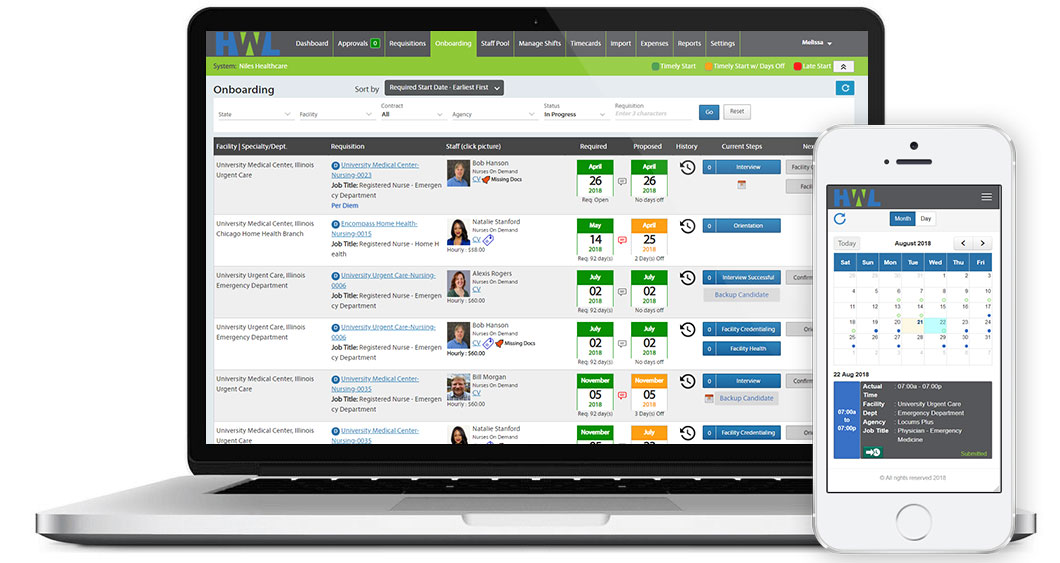
A VMS is a web-based software system that helps manage independent and contract staffing needs. It is most often utilized by hospitals, practices, and smaller businesses. VMSs assist healthcare organizations by automating information storage systems while handing control over to the practice, rather than a 3rd-party business, as well as streamlining the process of finding and onboarding candidates from the contingent workforce. While it doesn't exactly find and recruit contingent staff candidates for the organization, it does simplify and manage all administrative processes associated with new hires and potential candidates.
A well-functioning VMS should offer benefits that are very specific to the management and hiring of contract workers, including but not limited to:
- Simplified billing
- Streamlined recruitment process
- Detailed reports
- Management of independent workers
- Vendor neutrality
This makes VMSs perfect for businesses with more candidates than available jobs.
You and your HR department will have to find your candidates, but a VMS will make onboarding, management, and payroll much easier.
A VMS can be directly used by a hospital or practice to manage contract talent or by an MSP hiring team for the hospital or practice.
VMS Implementation: Technical Requirements and Timeline
Implementing a VMS typically requires 60-90 days for full functionality. Organizations should plan for:
IT Infrastructure Requirements:
- Integration with existing HRIS and payroll systems
- Single sign-on (SSO) configuration
- Data security and HIPAA compliance verification
- User training and change management protocols
Phase 1 (Weeks 1-4): System setup, data migration, and initial integrations
Phase 2 (Weeks 5-8): User acceptance testing and workflow customization
Phase 3 (Weeks 9-12): Go-live, monitoring, and optimization
What Is an MSP?
Managed Service Providers or MSPs, are third-party businesses that manage certain departments on the business' behalf. An MSP can also work as a staffing or marketing agency by connecting freelancers with management. The goal of an MSP is to reduce the workload from HR when it comes to finding new hires.
An MSP is the perfect solution for hospitals that are short-staffed or face varying staffing needs, particularly during volatile situations such as labor shortages. The MSP takes away the worry by finding and managing the right candidates for the job.
Benefits of an MSP include:
- Finding quality candidates to fill vacancies or work short-term
- Providing one master contract versus individual agreements
- Streamlining recruitment processes
- Allowing more time for HR to focus on patients and full-time employees
- Improving staff turnover rates
- Recording data to help future staffing plans and needs
- Cutting wasted spending
Larger hospitals and practices benefit best from an MSP as they cut down on time, costs, and workload.
However, many MSP companies use a VMS to optimize the process of connecting independent workers with businesses in need of additional staffing.
MSP Implementation: Speed and Service Delivery
MSP implementation typically takes 30-60 days for full functionality, making it faster to deploy than VMS solutions. The accelerated timeline reflects the service-oriented nature of the model:
Implementation Timeline:
Phase 1 (Weeks 1-2): Contract execution and service level agreement (SLA) establishment
Phase 2 (Weeks 3-6): Vendor network activation and candidate pipeline development
Phase 3 (Weeks 7-8): Performance monitoring and optimization protocols
The shorter timeline is possible because the MSP handles most technical infrastructure requirements internally, requiring less integration with the client's existing systems.
The Breakdown: VMS vs. MSP
An MSP is a third-party business that takes over a part of the healthcare organization so it may focus efforts elsewhere. A VMS is a technology solution for hospitals, practices, and smaller businesses that automates and streamlines HR functions such as hiring, onboarding, and payroll for contracted staff. While MSPs and VMSs have the same goal when it comes to improving efficiency in healthcare by managing contingent workers, there are a few key differences.
Here, we'll go over how to know if an MSP or VMS is best for your hospital or practice.
VMS vs. MSP: Side-by-Side Comparison
Feature VMS MSP Primary Function Technology platform for workflow automation Full-service workforce management Implementation Timeline 60-90 days 30-60 days Cost Structure Software licensing + internal staff costs Service fees (typically 2-8% of spend) Control Level High - organization maintains direct control Medium - shared control with MSP partner Scalability Manages thousands of workers without proportional staff increases Requires MSP team scaling for volume increases Vendor Management Organization manages vendor relationships MSP manages all vendor relationships Best Fit Scenario Organizations with existing contingent workforce and internal recruitment capabilities Organizations needing full-service workforce management Technology Requirements High - requires IT integration and maintenance Low - MSP handles technology infrastructure Market Access Limited to organization's existing vendor network Broad access through MSP's vendor network
Advantages of MSP for Hospitals and Practices
Larger healthcare providers will most likely benefit from an MSP. MSP companies work as a partner with hospitals and healthcare practices to connect talented contingent candidates that best fit the company's needs. Hospitals and practices that require more contract workers will therefore save time and money and are able to reallocate their efforts to higher organizational priorities. This is also true for hospitals that have varying staffing needs throughout the year.
An MSP will take over the entire recruitment process from beginning to end leaving only the final decision to hire to the hospital.
If your hospital or practice is always in need of contingent workers, an MSP will go above and beyond to meet your needs.
Advantages of VMS for Healthcare Providers
A VMS is great for big and small companies that have an existing pool of contingent candidates. Rather than spending extra money on an MSP to find candidates for you, you can focus on streamlining your current HR processes.
In addition to speeding up the onboarding process, a VMS stores data, candidate information, payroll, and invoicing. All information regarding your contingent workers can be found in a centralized, easy-to-access software platform.
You'll find contingent candidates will get through onboarding much faster with a VMS. This means contingent workers at your hospital can get to work sooner which saves money and improves care and services.
With a VMS, you remain in control of the recruitment process. Your hospital or practice will spend more time providing outstanding care with a VMS.
The Scalability Advantage: VMS for Growing Organizations
One of the most significant advantages of a VMS lies in its scalability architecture. Unlike traditional workforce management models that require proportional increases in administrative staff, a well-implemented VMS can manage exponential growth in contingent workforce volume.
Scalability Without Proportional Cost Increases:
- A VMS can manage 10,000 contingent workers with the same core administrative team that manages 1,000
- Automated workflows handle increased transaction volumes without additional human intervention
- Global workforce management becomes feasible without geographic limitations
- Real-time data processing capabilities scale automatically with volume
For healthcare systems experiencing rapid growth, geographic expansion, or seasonal fluctuations, this scalability represents a strategic competitive advantage. Organizations can respond to market opportunities without the lag time of building internal capacity.
MSP and VMS as Complementary Solutions
Rather than viewing MSP and VMS as competing alternatives, forward-thinking healthcare organizations are discovering the power of hybrid approaches that leverage both solutions strategically.
The Hybrid Model: Best of Both Worlds
VMS for High-Volume, Predictable Roles:
Organizations can use VMS technology to manage routine, high-volume contingent staffing needs—such as per diem nursing, administrative support, and standard allied health positions. The automation and control benefits of VMS excel in these scenarios.
MSP for Specialized, Complex Placements:
Simultaneously, the same organization can engage an MSP for complex, specialized roles that require extensive market knowledge—such as executive leadership interim placements, highly specialized clinical positions, or crisis staffing situations.
Strategic Benefits of the Hybrid Approach:
- Optimized cost structure: VMS efficiency for volume, MSP expertise for complexity
- Risk mitigation: Diversified workforce management approach
- Enhanced market access: VMS vendor networks plus MSP specialized relationships
- Scalable complexity management: Technology handles routine, humans handle exceptions
This complementary approach recognizes that different workforce challenges require different solutions, and the most effective strategy often combines technological efficiency with human expertise.
Save Time with Managed Services Providers and Vendor Management Systems
Whether you outsource your entire hiring process to an MSP or streamline it with a VMS, your healthcare business will save time and your HR department will thank you.
Working with contingent workers in your healthcare business gets unique and specialized talent to help with projects or cover open positions in times of crisis. Incorporating an MSP or a VMS takes the hassle out of contracting. Both full-time and contingent help can get to work faster to ensure your organization offers the best healthcare.
Choosing an MSP or a VMS depends on your hospital or practice's needs. If you have a pool of candidates to work with and prefer being in charge of all areas of the contract hiring process, a VMS is a great solution.
If you're a larger organization looking for a worry-free approach, an MSP will take care of the recruitment, management, and hiring for you.
However, the most strategic approach may involve both: using VMS technology for operational efficiency and MSP services for market access and specialized expertise. This hybrid model allows organizations to optimize costs while maintaining flexibility and comprehensive market reach.
Look Forward to New Forms of Work With HWL
As more and more talented individuals are turning to freelance and temporary gigs to make a living, companies are finding that contingent workers offer a great skill set and make valuable assets. With MSPs and VMSs, the recruitment, management, and hiring processes of contract workers is easy.
The healthcare workforce landscape continues to evolve, and successful organizations will be those that can adapt their workforce management strategies to meet changing demands while maintaining quality and cost-effectiveness.
Looking to learn more about MSPs and VMSs to improve your hiring process? Let us know, we’re happy to find the perfect solution for you and your hospital or practice.